
Bleckley County Criminal Docket Searches
Felony and other Superior Court matters start with the Bleckley County Clerk of Superior Court. Its Case Search link opens Icon WebCaseSearch. The public landing screen is login-gated, so there is no anonymous name or case-number box for a docket search. Account holders sign in with a UserID and password. Without an account, the clerk's free calendar index still works, and the criminal records staff can pull the public index or a named court record.
The right route depends on the charge. Magistrate Court holds warrant and preliminary-hearing work. Probate and Cochran Municipal Courts may keep traffic or ordinance-level cases. The Superior clerk, not the arresting agency or a commercial background site, is the final custodian of the felony docket.
- Identify the court and approximate year.
- Open Icon if an existing account is available.
- Check the clerk’s dated plea, arraignment, motions, or term calendar.
- Match the exact case number and case style.
- Ask the correct clerk for the public order, disposition, or certified copy.
Bleckley Criminal Docket Login Limits
The Georgia E-Access directory lists Bleckley Superior Court. It routes users to PeachCourt, with a warning that an account is required. PeachCourt also serves as an e-filing provider. Filing a document is one task. Reading a calendar PDF is another, and ordering a certified record is a third. No free guest search is offered. A failed login points back to the clerk, not to guessed portal features.
The PeachCourt vendor page names the system the judiciary uses for access and filing.
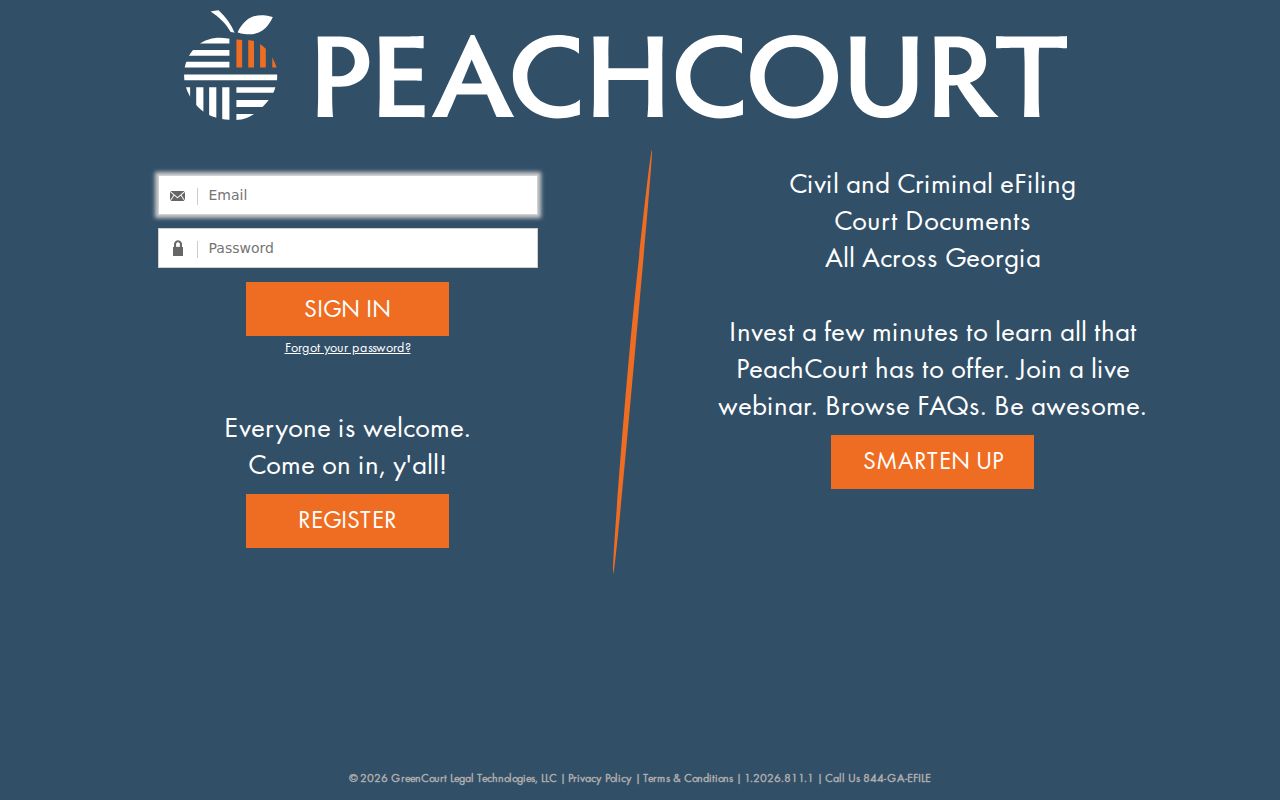
An official account route helps confirm access, but it does not turn a web view into a clerk-certified criminal record. The screen is still just a screen.
Note: A calendar PDF is free to read, while account, copy, certification, and mailing costs must be confirmed with the clerk.
Criminal Dockets: What They Show
A Bleckley County criminal calendar is a scheduling slice of the case record. It can list the court, case number, filing date, case style, count, charge, felony or misdemeanor classification, offense date, plea, attorney role, bond data, judge, and setting. The full criminal docket adds more. Filed motions, orders, disposition, and appeal events appear there. No clickable indictment, sentence, or judgment comes with it.
| Case number | The local calendar identifier, copied with all letters and punctuation. |
|---|---|
| Count and charge | Each allegation and its listed classification, not proof of guilt. |
| Plea | A procedural response and date, which may precede the outcome. |
| Bond | Release security, amount, and date where listed, not the disposition. |
| Setting | The session type, date, time, and assigned judge. |
| Disposition | The recorded outcome, best confirmed in the signed order or sentence. |
Bleckley Criminal Docket Plea Labels
A plea calendar explains why the court assembled it. It promises no resolutions that day. "Not guilty" is a plea, not an acquittal. A motions calendar may end with a ruling, or with an order filed later. A revocation, bond, and plea calendar mixes several proceeding types, so the individual docket entry and notice control.
- Arraignment
- The hearing where charges and a plea are addressed.
- Nolle prosequi
- A prosecutor’s formal choice not to continue a charge at that time.
- Continuance
- A setting moved to another date; the prior entry stays in the history.
- Disposition
- The recorded result, such as dismissal, plea, conviction, acquittal, or transfer.
Note: Removal from a newer calendar does not prove dismissal; the matter may have moved, resolved, or appeared on another list.
Criminal Case Stages on the Docket
The core Bleckley County criminal docket flow is: Filing → Arraignment → Pretrial → Plea or Trial → Disposition → Sentencing. A felony may begin with warrant or preliminary work in Magistrate Court before the accusation or indictment becomes part of the Superior Court case. Bond review and motions can appear between the main stages. Some cases skip stages, combine them at one setting, or end through dismissal or transfer.
Read docket events in date order. Keep the offense date apart from the filing date, and a hearing date apart from the date an order was entered. An appeal opens a new appellate docket. The trial court file still holds the core pleadings and the signed judgment.
Bleckley Criminal Docket Record Layers
Three layers of records get confused. The docket is a dated index of events. A filed document is what the entry names. Think indictment, motion, order, or sentence. A certified copy bears the clerk's attestation and is ordered from the custodian. The free calendar is the narrowest, since it lists scheduled matters rather than the full history.
| Record | Best use | Source |
|---|---|---|
| Calendar PDF | Check a listed setting | Clerk calendar index |
| Criminal docket | Trace case events | Icon or Superior clerk |
| Filed order | Read the judge’s terms | Correct court clerk |
| Certified sentence | Obtain authenticated proof | Superior clerk |
Bleckley County Criminal Docket Courts
Bleckley Superior Court holds the felony docket. Magistrate Court creates warrant and preliminary-hearing records. It never becomes the felony trial court. Probate Court and Cochran Municipal Court keep cases within their own traffic, misdemeanor, or ordinance jurisdiction. Copies may sit with the District Attorney or defense counsel, but neither keeps the official docket.
| Court | Criminal work | Custodian |
|---|---|---|
| Superior | Felonies and related proceedings | Clerk of Superior Court |
| Magistrate | Warrants and preliminary hearings | Magistrate Court |
| Probate | Assigned county traffic or misdemeanor matters | Probate Court |
| Cochran Municipal | City ordinance and city-issued traffic cases | Municipal Court |
Bleckley Criminal Docket Desk Access
The official clerk profile credits the Bleckley clerk with managing Superior and Juvenile Court records. Criminal work sits in its own part of the office.
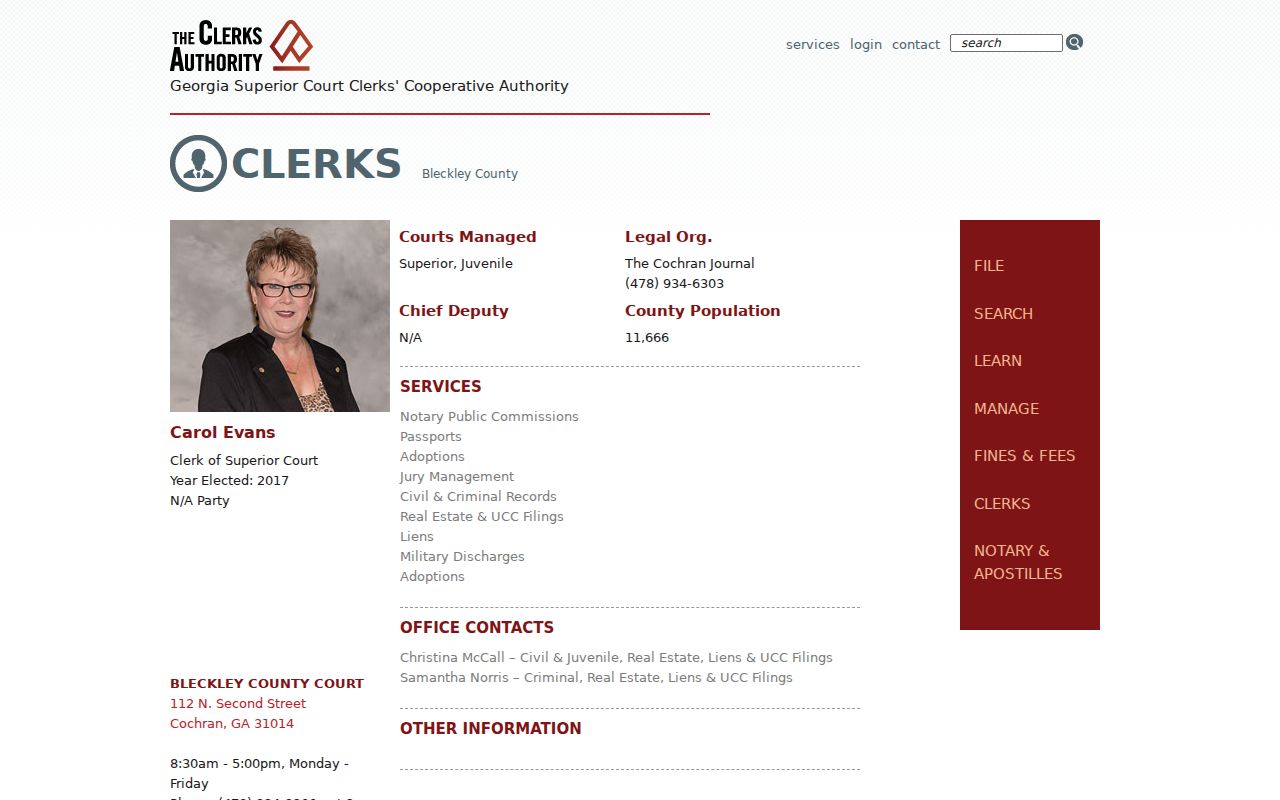
That profile supports a direct request to the criminal desk. Bring specifics. Name the court and the party style. Include the case number if known, the approximate year, and the exact document. Ask about inspection, search charges, and per-page fees. Certification, accepted payment, identification, and turnaround are worth asking about too. No complete fee sheet or public-terminal policy is published.
Staff can scope in-person, telephone, fax, and mail contact. The office sits at 112 North Second Street, Cochran, Georgia 31014. Call 478-934-3200 and choose option 2 for the Superior clerk. The published fax is 478-934-6671. Do not assume email or online certified-copy ordering is accepted.
Access Rules for Criminal Dockets
Uniform Superior Court Rule 21 starts from public inspection. Law or the court's limitation procedure can carve out exceptions. A restriction order must say what is limited, why, and for how long. The privacy harm must clearly outweigh public access. Redaction hides protected data and leaves the rest public. Sealing limits access to an item or file. Georgia criminal-history restriction is a separate process, and it does not erase every court reference.
Key Rules:
Uniform Superior Court Rule 21 sets the public-access baseline and limitation process.
O.C.G.A. § 9-11-7.1 addresses protected identifiers and redaction.
O.C.G.A. § 35-3-37 resources explain criminal-history restriction and related court steps.
Juvenile, adoption, some mental-health, grand-jury, and sealed materials carry special limits. Check spelling, court, and year on a miss. Ask for the public index or any redacted remainder. If denied, request the law or order that controls it.
Bleckley Criminal Docket Data Limits
Want a statewide view of criminal court activity? The Georgia Criminal Case Data Exchange dashboard reports disposition data that courts send through a state exchange. You can filter it by county and court class, and it refreshes on a set cycle.
One caution applies. The dashboard counts exchanged criminal disposition records. It does not count every Bleckley County filing, so treat it as system context rather than proof of any case. For a named Bleckley County criminal case, the court docket, the signed order, and the clerk's confirmation are what count. Exchange totals are never the county's full criminal caseload.
Filtering by county takes context too. Transmission reports only reflect records routed through the state exchange. The reporting cycle can also lag behind the clerk's live case file. So a zero, a dip, or a spike may come from timing, court class, or data quality. It may not reflect a true shift in crime or filings. Before citing broad statistics, state the measure, the date, and the filter exactly as applied. That discipline keeps administrative data from being mistaken for one person's outcome or the county's complete workload.